
Standing in the Middle with Jesse Welles
Article by Aidan Heilman
Jesse Welles has been releasing music under various pseudonyms and in different bands as early as 2012 in Arkansas, where he was born and raised. His most recent band, Welles, formed in Nashville and released one full studio rock album, “Red Trees and White Trashes” in 2018 under 300 Entertainment. They have since been largely inactive through and post Covid-19. Jesse Welles began his new solo career under his real name posting Tik Tok videos of himself singing folk protest songs, which quickly gained traction over the course of the year. At present, Jesse Welles has amassed a following of over one million people on both TikTok and Instagram. His songs cover a wide range of topics from personal anecdotes to poverty, cancer, corporations, the olympics, bugs, war, and more. His frank but poetic commentary on the state of the world sung over folk rock compositions has propelled him to an unprecedented level of fame relatively quickly. Jesse Welles has released three albums over the last year: “Hells Welles”, “Patchwork”, and “Middle”, the last of which was the first recorded fully in studio with a band to back Welles’s songwriting. In support of all three albums, Welles has been on his Fear Is The Mind Killer tour which extends through North America and Europe. The tour included a stop at Lincoln Hall in Chicago, which I was ecstatic to attend.
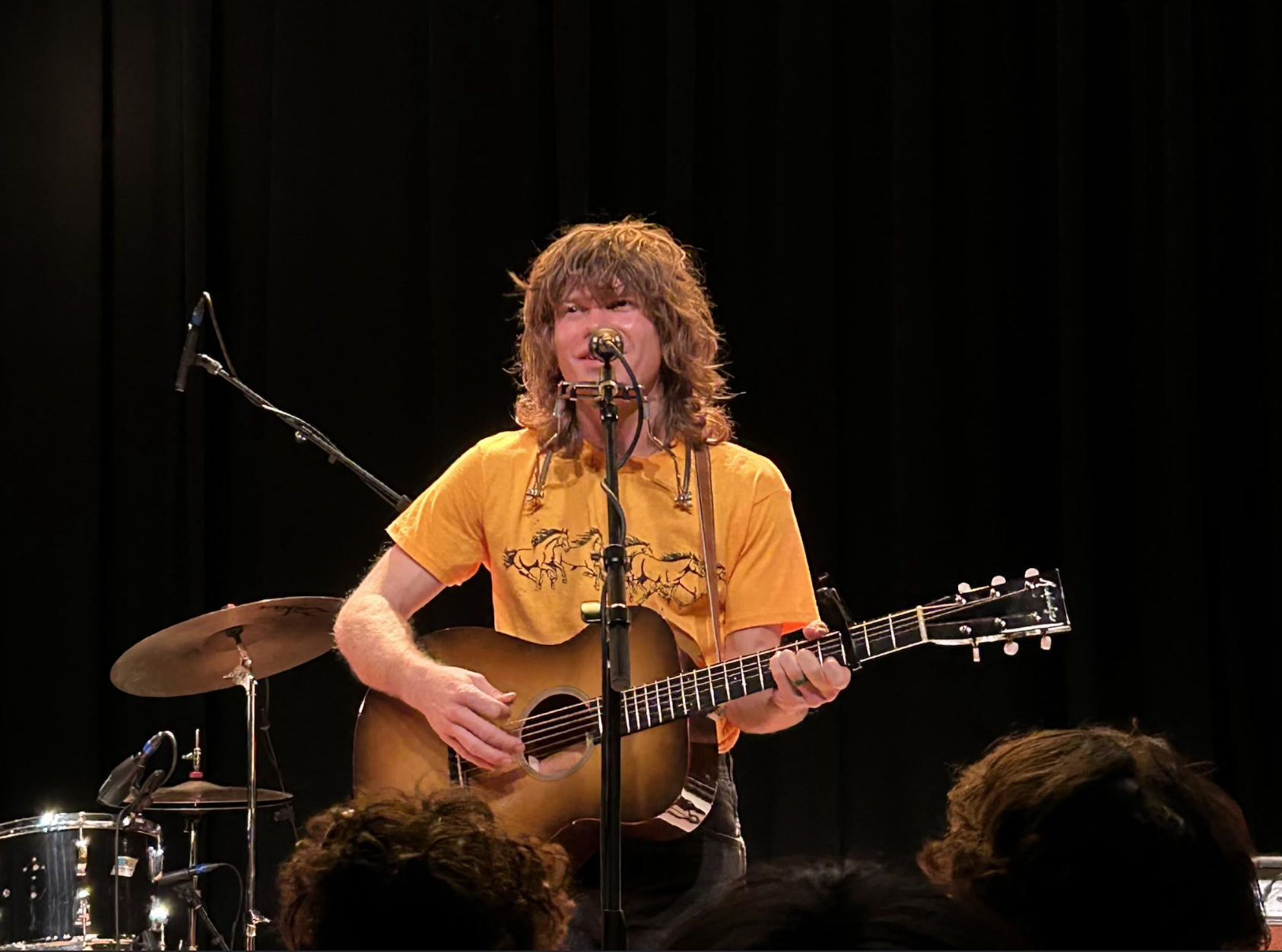
Jesse Welles walked out onto the warmly lit stage alone in a yellow tee with horses on the front just past showtime. He picked up his guitar, got his harmonica settled, and simply said “If you know em, you can sing em” to a silent audience full of anticipation. He opened up the set with his song “Fat”, a commentary on the American obesity epidemic and food industry, to which the crowd sang with smiles all around. “Fat” was followed by “Walmart”, “Slaves”, “Fentanyl”, “United Health”, and a cover of “Knockin on Heaven’s Door” by Bob Dylan, among other songs from his first two albums. About an hour into the set after playing “Bugs”, Jesse Welles brought out “the fellas” mid-song. The band, consisting of a bassist and drummer, joined in just after the intro section of “I’m Sorry” with perfect timing, which rejuvenated the crowd and brought a new level of energy to the set. The rest of the performance primarily consisted of songs off of “Middle”, along with a cover of “Have You Ever Seen The Rain” by Creedence Clearwater Revival and “Sweet Jane” by The Velvet Underground. The crowd danced and sang until the end.

Many artists use a lot of stage production, such as fancy lights, props, and projections, but not Jesse Welles. The lights didn’t move or change color for the entirety of the set, just bright enough to engulf the stage in a warm glow. Welles similarly did not jump around or perform many elaborate movements during the set. Instead, everything was kept simple. The simplicity of all things kept the performance pleasantly intimate, with little separation between the band and the audience besides the height of the stage. The audience was fully engaged for the entirety of the performance. Between songs it was so quiet one could almost hear a pin drop, aside from the occasional quip from Welles. “Is it a new moon? You’re supposed to plant carrots, I read it in the almanac”, he said after playing “New Moon”.
The show was simple in the spirit of folk, but the music itself was more than enough to keep the audience entirely engaged until the end. The acoustic guitar solos, harmonica riffs, introduction of a band halfway through, Jesse’s good energy, and most of all his lyricism compounded together to create a wonderful show that built itself upon and paid homage to all that came before it. In folk music, there has been a long tradition of storytelling and protest in the lyrics. To see Jesse Welles bringing the heart of folk to the forefront and continuing that tradition when the world needs it is a wonderful thing to be a part of.