
BOWLING FOR SOUP REVS UP FOR RIOT FEST: AN INTERVIEW WITH FRONTMAN Jaret Reddick
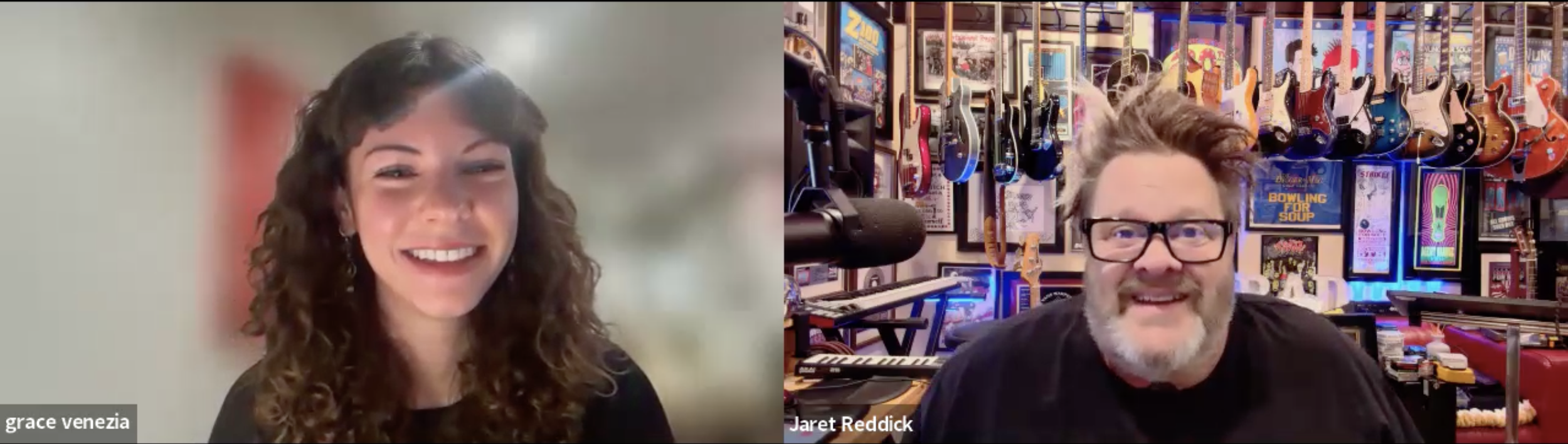
Interview by Grace Venezia // Produced by Jack Iboshi
On Wednesday morning, WLUW’s Grace Venezia sat down with Jaret Reddick, Bowling for Soup’s frontman, in preparation for their upcoming performance at Riot Fest 2026. Hailing from Wichita Falls Texas in 1994, the group made a name for themselves in the Pop Punk scene with titles such as 1985, Girl all the Bad Guys Want, and for the younger crowd, the Phineas and Ferb Theme Song.
From the art of travel chemistry to the nature of live performance, Reddick shows us what it means to have a love of the game.
Grace Venezia: When it comes to touring, how do you deal with the close contact and cramped rooms?
Jaret Reddick: Yeah, you know, we do pretty good. I mean, we have a really good balance of everybody's sort of finding their spot, you know, and so usually if the band is in the dressing room, then the crew will sort of spread out, like, some will go to the bus, and a lot of times our schedules are kind of intertwined, and so by the time we're in there, they're kind of done with the first part of their day, and so it works out alright. It helps that we like each other, and so, quite frankly, the close quarters don't really bother us that much, and it's like, well, I tell you this, the progression is nice. I mean, you go from a van, right, we did 9 years into a van, and then you get into a tour bus, and then you get into a nicer tour bus and then you get into a tour bus that's got pop-outs. So as long as we can park in an area where the pop-out is, where we can put it out, then we're doing alright.
GV: Yeah, honestly, travel chemistry is a real thing.
JR: Yeah, I mean, travel chemistry is important. To me, it's almost as important as a skill set. It's like, even when Eric left the band in 2017 and got the job was because he had already set in for Gary when Gary was having a baby the summer before, and well, I guess his wife had the baby.
But Gary needed to be there. So we already knew we could tour with him. I mean, that's a huge, huge bonus, because I have other friends that I've done things with in the past, and then we go on the road, and I'm like, okay, well, we'll keep our friendship over here, and touring is over here, you know?
You're so right. I mean, that's just it. And in life, too, right? Like, you have those friends that you like to vacation with, and then you have those friends where you're just like, this is more of a lunch or drinks friend.
GV: Exactly. Even with a college roommate, it's like, who do you keep your friend and who can you actually live with?
JR: That's a great example, actually, because my son is in college, and his roommates are his close friends, but he has different friend groups for different things that he does. And the college roommate thing is so important, because they've gotta be able to argue over who does the dishes and who ate somebody's burrito, you know?
GV: Does your son follow in the musical path?
JR: He doesn't, he's not really interested. I mean, he likes to come out and be a part of this stuff, and he'll come out to big festival shows, and I'll hire him to help with merch. So he just gets the whole day to go and mess around. It's actually my youngest son; two older kids, 23 and 20, and my 13-year-old, who's about to be 14 in a week.
He actually is our musician. He's doing really well, piano, drums, he's in jazz band and concert band in school, and so, we'll see. Again, it's one of those things around that age where, for me, anyway, and most of my friends, our parents quit telling us we had to practice. It's sort of like when you know this kid's gonna be into it, or they're not. Honestly, we don't even mind if he's practicing what he's supposed to be practicing. Like, as long as you're playing, that's great. But yeah, he seems to be into it, so we'll see.
GV: He’ll be following in your footsteps, if so.
JR: Yeah, I mean, I wouldn't hate it, you know? It would be nice to be able to guide someone, but at the same time, you know, I have so many friends whose kids are, like, out there doing it now, like, gigging and in some cases, touring and stuff like that, and I mean, you can try and guide those things and be the mentor and all that, but unless they're ready to receive that, you're just better off to watch the show and just try and move obstacles the best way you can and help them navigate.
GV: Totally. Though, music can go beyond industry. It could also just be jamming with your dad, if that's what you're looking forward to.
JR: Man, that's rule number one. Do it because it makes you happy, you know? Honestly, anybody who is out there playing music to “make it,” it's just the wrong reason to get into it, because the heartbreak is real.
I mean, we're 32 years in, and still to this day, I don't get excited about anything until I'm on the plane, or I've signed the paper, or I see it on TV, because you just get told no a lot and it's even more than actors and stuff — at least their auditions are spread out. As a musician, every day, it seems like, you know, somebody's not digging something that you put out there or whatever, so it's definitely not something that I recommend anyone getting into to “make it.” It's something you do because you love, and yeah, that's a gift that he can have forever. I used to tell him, I mean, I told all my kids this. I was just like, you hate piano lessons, but if you're the kid that goes to the high school party, and they have a piano, and you sit down behind that piano, and you start playing— you have no idea how that feels. It's the greatest feeling, and I think he's kind of starting to figure that out.
GV: Yeah, yeah. Starting as a band kid can be a tough origin, but once you break through that threshold of band kid to musician. The world is your oyster.
JR: I know, were you a band kid?
GV: I was a choir kid, and into musical theater.
JR: So I'm theater too. So theater kid, band kid, yeah.
And it was glorious. Like, as you said, like, you know, I had that group of friends that it was super easy to stay out of trouble, and we were all working towards this same goal all the time, and then you've kind of got these friends over here that are just in rock bands too, but it's cool to have those circles. And, you're so right. I mean, I was like the cool kid in a band, I had really long hair, and I was in a band, so, it was nice. You know, the hierarchy there was cool, because I wasn't necessarily cool outside of that group.
GV: So, coming out of Texas, you pretty quickly made a name in the pop-punk scene. Is that was the genre that you set out into, or was it the music that dictated your direction?
JR: It's definitely the music, because really, pop punk wasn't a thing. I mean, we started in 94, and we were in Texas, and quite frankly, nobody sounded like us, and it was really hard to find a spot.
We grew up in Wichita Falls, Texas, and once we got down to the Dallas area, we started to find a few more here and there, but they were all really kind of a punk-leaning thing, you know, whereas, we all still had long hair, and our whole thing was just fun and joy.
And we learned really quickly that we didn't quite fit into all the punk circles when we did a punk show at a place — an old abandoned theater with, like, 30 punk bands — and during our set, they were lighting paper airplanes on fire, and, throwing them at us while we were playing, yelling, “kill the hippies.”
And, you know, all these guys had the mohawks and the leather jackets, and that was not really ever our style. So, it was one of those things where we thought we were a punk band, but we really couldn't put our finger on it. And then the 2000s entered the picture, and we, yeah, as you said, we started to get a little bit of popularity, and started to realize, oh, okay, like, this kind of exists outside of this world
It wasn't really until later that we realized that we had been in it from the beginning, or at least the beginning of the popularization of it. We trace pop-punk back to the Descendants, who started in 81, and who were still active, but really, it didn't become a genre until the late 90s, early 2000s
It was definitely one of those things where the music drove the ship. Again, we would say sometimes we were a punk band, sometimes we'd say we were a rock band, sometimes we'd say, you know, yeah, we're just a fun band, you know, we really didn't know what to say we were in the early days.
GV: Was it threading that line that made you stand out?
JR: Yeah, I think the biggest thing that made us stand out, besides, well, being from Texas was a big deal.
For us, because, again, there really aren't a lot… I mean, we have Phoenix TX who came around, and then there's other bands, Dynamite Boy, and a few other pop-punk bands that came out of here at one point, but, you know, in the early days, we certainly didn't know that that existed. So what made us stand out, really, was the humor, the live show. Our live show is a lot of ad-lib, there's a lot of banter involved in it, a lot of including the audience, kind of, like, stopping in the middle of a song because something happens over here, and discussing it, and then going into another song, you know?
That's the kind of thing that we did to entertain ourselves and really set us apart. But yeah, I mean, we compared ourselves to Cheap Trick, which is, you know, a rock band, just as much as we did The Descendants in the early days. So you might be right. I mean not really having a club, so to speak, or a genre to latch onto, it made us different, and it made other bands want to play with us, eventually, you know, once we got to the point where that was a thing.
GV: It's interesting you bring up the audience response. The visual of the paper airplane sticks in my head. Was it hard to keep the passion or excitement alive when you have so much critique as a startup band?
JR: Yeah, I mean, and for us, it was really hard, because our hometown really, really did not latch onto us at all. I mean, it was “cover band” or nothing in Wichita Falls, and then when we got to Denton, we had a little taste of people liking us, but we would go out, and as you said, you have to start playing to 8 people, but I sort of figured out a formula really quickly in other towns, how to make 8 turn to 16, and 16 turn to 32, and you know, 10 trips in, you're selling out, and that's where we found ourselves. Like, by 98, 99, we had 10 or 15 markets in Texas and the surrounding states where we could go and just blow the roof off the place.
We were working covers into those sets and things like that, but we weren't necessarily a cover band. And, so yeah, you know, it was difficult. I mean, it's, you know, you drive 2 hours to play a show, and 3 people show up. You gotta really love what you're doing, and the people you're doing it with, and that's really where we were lucky
9 years in that van. Driving around, even after the bitch song, even after we got signed, a lot of time playing to nobody, and I mean, I remember, like, Girl all the Bad Guys was already a hit in the States, and we were playing one of our first shows in Canada, and just this redneck guy comes up to the stage in, like, boots and jeans, and just in the middle of our song that we're playing that's, like, on this major label record, and it's just yelling Metallica at me, you know, in my face, and there's nobody else even close to us, you know, and those shows are definitely the ones where you really, really gotta love what you're doing.
GV: So was that a skill you had to develop to avoid burnout?
JR: Yeah, the big skill was entertaining each other, and we still do it. And so, that is the secret, really, to Bowling for Soup, is that we're having more fun than you are. And the days are long, you know, I mean, we miss home, we're not always happy, sometimes we're sick, you know, but the 45 to 90 minutes that we're on that stage, we've crossed over into an area of, like, alright, we get to do this together for a living, let's make each other laugh, let's have fun with it, you know? And honestly, to this day, 32 years in, as I said, a couple of member changes, and it's still like that.
I mean, we're walking to the stage, and it's been a long drive, it's been a long day, whatever it is that's built up around us, and you need that adrenaline, and it's just not kicking in yet, you know, and you're walking and you're all three on the same page, and even the crew, you can see it in their faces.
And then the theme song goes off, and it just happens, and you know, your shoulders come back, and you breathe more, the crew all starts smiling, and like, and it's just like, oh, okay, now we're delivering this show, but also, like look at us! We're hanging out, and having a freaking great time, and people are watching us do it, you know? So, yeah, that's such a huge part of why I think we have the longevity that we have, is that we've never had that boredom of it, or internal conflict that makes it hard to get up there and play a show.
GV: Absolutely and your music videos and performances are just as notorious as the music itself. Is the visual aspect of performance just as natural as the music?
JR: Yeah, I always say to everybody, you know, I wasn't really very good at guitar when I started this band. I'm a drummer, and I was raised a drummer. I'm an educated drummer, I can still read drum music, which is nice, because my kid is playing drums, and I'm able to help. He's actually passed me, as far as that goes, but you know, I just picked up a guitar to start writing songs. So I really am not educated in that way. Especially the first several years of Bowling for Soup, like, I was just really going through the motions, but I made it look good, you know? I just always say, if you look like you know what you're doing then people just buy it.
If you get in the stance, make the face, people are just like, this guy means it, he knows what he's doing, and that's a big part of it, for sure.
It goes back to what you said earlier, you know, those hard days of playing to nobody, or playing to an audience that could care less, or playing to an audience that hates your guts. If you're just out there with the confidence of, like, oh, okay, well then, here's this; it's crazy how you can just win people over, you know? Yeah. And then all of a sudden, that guy in those boots yelling Metallica at me in Canada is out there, grabs a girl, and starts two-stepping to Girl all the Bad Guys Want, you know what I mean?
But if you're pausing in between songs, and you're going and getting a drink of water, and you're talking to your drummer about how terrible it is, people can feel that. And so that's been a gift.
To me, as I said, as a theater kid of just, like, I can't stand making the audience uncomfortable unless I mean to make them uncomfortable, you know? Like, if it's an uncomfortable joke, I will sell it. But, if it's just that I need a drink of water, and nobody else is near a microphone, I'm not gonna let it be quiet, I'll just go without.
GV: Do you find yourself tailoring your show to the region that you're in or the audience you’re playing to?
JR: Well, in those days, it was literally night by night. I mean, it's city by city, it's club by club. I mean, two clubs in the same town back then. When you're drawing, you know, 50 to 300 people, one just across town is a completely different crowd.
Again, a big part of our education, of 9 years in the van, and going and doing these little towns around here, and winning them over, that education of, like, oh, we can win over anybody, and that's just it. I still feel this way.
I do feel sorry for 95% of bands that have to play after us. I really do. And I mean that, and I think if you've ever seen us play, you know why. Because we're 3 dudes, we don't have any tracks, no extra musicians or whatever. Three guys go up there and make it sound like the CD every night, and then make you laugh.
And all of that, and I'm… I say it confidently because I'm proud of it, you know? It's not a conceited thing, it's really just, like, this is reality, like, we're gonna go up there and absolutely blow the roof off this place, and make everybody in here laugh, and then if you're after us, like, you get to go after that, you know?
GV: Do you ever compare it to your own performance or how you've done in the past?
JR: You know, one great gift that I got, as I started to get a little older, I gained some weight, and I went through a sort of a dark period with mental health, or whatever, and if anyone out there is interested in that, please come follow me, and I do talk a lot about mental health awareness, and I have some things to say about that. But, I went through a fairly dark time, and as I said, I stopped moving, I gained some weight, I got a little older, my knees are bad from jumping off of stuff whenever I was, you know, when we were young.
And I realized at one point that I wasn't moving as much on stage, you know, I'm not really jumping around, and then Chris left the band, or retired, and I'm tied to the microphone all the time now. I can't really get into a guitar thing and run over there, because I've got to be back to sing
But the gift that I received, long-winded answer, was that people just talk about our energy all the time. They're like, y'all have so much energy, and it's just such a gift, because I was being a little critical of myself, and thinking about, man, dude, you used to jump off things, and you used to run over here, and blah blah blah, and don't get me wrong, I still move around the stage, but again, I'm pretty contained in one area, because I have to be able to play all the parts and get back to that microphone. Yeah. And so, you know, the fact that people still see our show as being one of the most energetic when we're playing with a lot of young kids these days who can still do the jumping and the flipping and the things, you know. That's been a really nice gift for me, and it took a pressure valve, and sort of just released that
Now I just own it and do my thing, and I feel like it made me better.
GV: You've been to Riot Fest once before. What do you expect to be different about the show this Sunday?
JR: Well, first of all, I'm very excited to be playing before Insane Clown Posse, because for whatever reason, juggalos love Bowling for Soup, and I love Juggalos because they're just crazy and fun and in it for the right reasons, for the most part.
So I'm really excited about that. The downer is that we're not playing on the same day as some of our closest friends, but I am really, really excited because this is the same stage where we watched Pennywise and Faith No More last time we were… oh, no, Mr. Bungle, last time we were there at Riot Fest a few years ago, and so, I know the stage, and the crowd's gonna be crazy and awesome, and it's Good Riddance, Bowling for Soup, and Insane Clown Posse. That's a pretty cool little hat trick.
GV: Definitely. So, I have one last question for you. When it comes to your history, some of your most popular tracks are about nostalgia and getting older. So, when it comes to leaving a musical legacy, how do you want your fans to remember you?
JR: I hope that they remember us as being real and fun. You know, I mean what I say, and I say what I mean, and that's in interviews and everything. I hope that we're the band that makes me happy. You know, that was my go-to band, and I hope they pass that down, and I feel like they do, because even young kids come up now and are just like, you guys are such a relief, because you're so fun, and and you know what's great about that? It sort of goes back to that energy thing that we were talking about.
Because not all of our songs are fun.
I mean, there's poignant stuff out there, and I do sing about mental health, and I sing about, heartbreak and things like that, but the fact that those happy moments in our songs are the ones that sort of really keep people elevated, you know, that's what I hope our legacy is, and I think it is, I really do.
GV: Well, I'm looking forward to seeing you this Sunday, and of course, please stop by the WLUW booth. I know on your site you say that you consider yourself the 9th greatest pop-punk band. So, I hope that you'll consider me the at least 9th greatest college radio interviewer.
JR: This is, this is the best college interview, I'm not joking, that I have done… I mean, in a long time. I honestly didn't know this was college radio until we had already been on here for 10 minutes, and then you told me. So you're already killing it.
Transcription edited for length and clarity
