
Article and Photo by Jack Iboshi
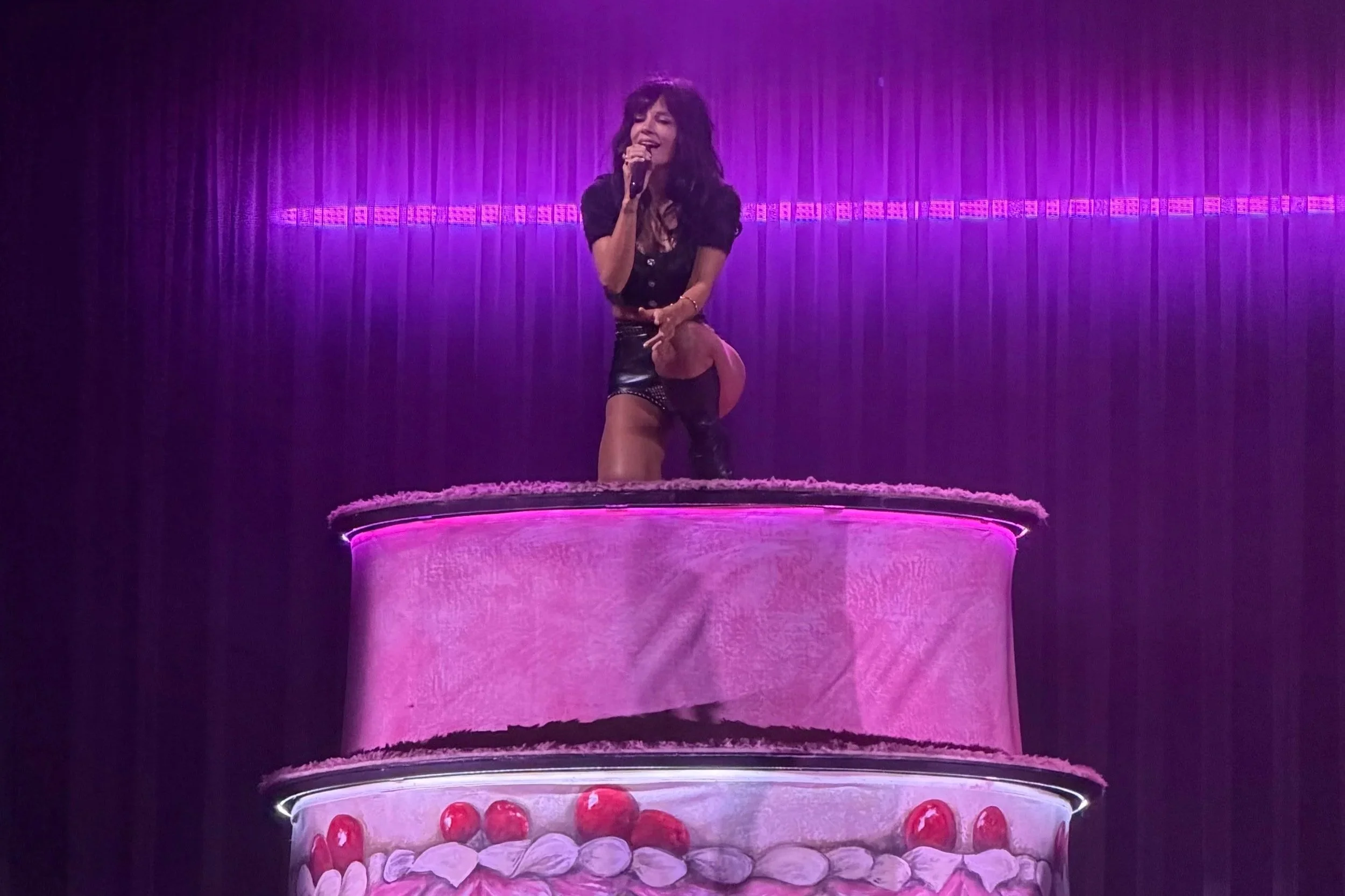
For Lily Allen, West End Girl could never be confined to just headphones. Built around the collapse of her marriage and shaped by the years she spent acting on London’s West End, the album already plays like a piece of theater: sharply written, deeply narrative, and uncomfortably specific. At the Chicago Theatre, Allen brings that story from the West End to the Midwest, attempting to turn one of the most vivid albums of her career into a fully staged production. For all its West End ambition, though, Allen’s Midwest performance occasionally lands somewhere closer to the “Mid.”
Allen’s routine of West End Girl is a creative risk that debuts a newer, more mature artist. The 45-minute show is a complete playback of the record, pulling on the strong transitions and vivid storytelling she had sewn into the album. Her time on the West End was not just a foundation for the project, but a clear training ground. Opening with a phone call in “West End Girl” and an uncannily accurate American accent in “Madeline,” Allen’s re-enactment of the tears and anger she once drew on while creating the album showcases her as the award-winning actress she took time away from music to become. The songs are not performed like the playlist-friendly pop songs they may exist as elsewhere, but instead as individual story arcs opening the audience into every emotion she felt in the process of creating them.
The problem is that, while Allen brings the album’s story to life, the show itself never quite does. Her commitment to treating the album like scripture means she never touches another song from her catalog or strays from the album’s prepared dialogue. She borrows the narrative ambition of a jukebox musical, but only partially embraces what makes the form theatrical. More dialogue, character development or connective moments could have given these already familiar songs new meaning beyond what an audience would know from pressing play on Spotify.
She’s rightfully proud of the cohesive story she built in the album, but the production stops just short of fully adapting that story to the stage. There might not be much more Allen could say about her tumultuous marriage with how descriptive each lyric already reads, but if she is going to sacrifice the spontaneity and audience connection of a traditional concert for a tightly controlled stage production, there is room for that production to offer something beyond what is already embedded in the record. For such a raw, unfiltered album, her performance can feel surprisingly polished and strict. She spends only three words of the entire show acknowledging the crowd, letting out a quick “Thank you, Chicago.” Sprinting from song to song, the audience is fed only the crumbs of an occasional extended outro, while Allen’s dark silhouette awkwardly repositions onstage for the next song.
In the end, though, Allen truly does deserve the flowers she’s handed as she takes her final bow on stage. The routine of West End Girl is bold and proves her as someone who should be taken seriously as an artist. While it might have taken a messy and life-changing string of personal events, Allen is the strongest she’s ever been. She has an admirably clear vision for her artistry and a determined drive to make sure it’s executed her way.
Following the release of her fifth studio album West End Girl, Allen has continued to build momentum onstage with her headlining Lily Allen Performs West End Girl tour, bringing the record to life in full across the UK and North America. Fans can catch her continuing the West End Girl tour in Minneapolis, Morrison, Los Angeles, Oakland, Seattle and Vancouver as she continues one of the biggest headline runs of her career. To stream West End Girl or to catch her live, visit lilyallenmusic.com.